
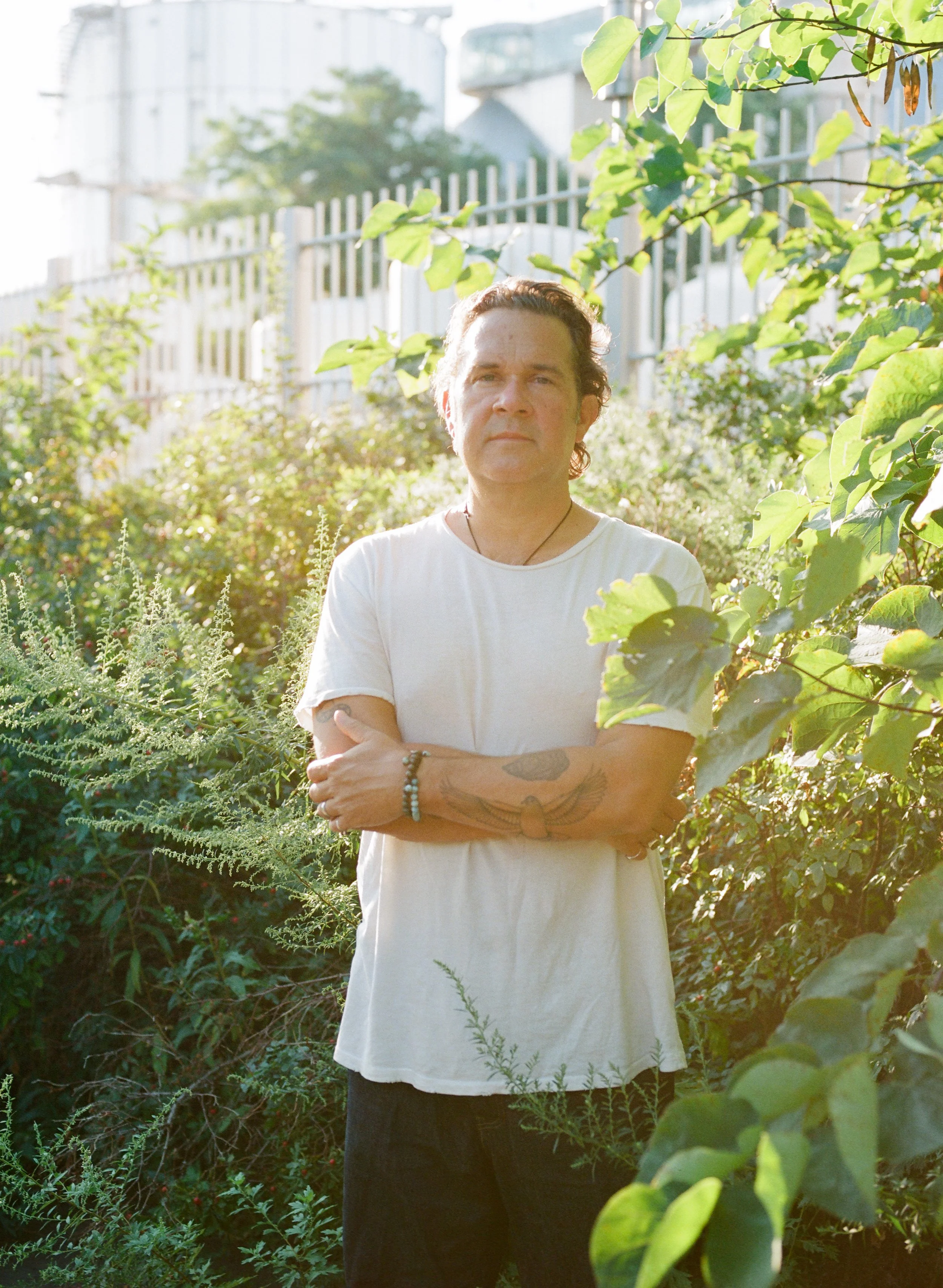
Click Image to Download!







One of the very first sounds on The Wheel is a child's voice.
"That's me as a two year old, playing with my mom and dad in Santa Ana, California," Jamison Wake says.
A keyboard swells into the background. A soundscape builds. The atmosphere is nostalgic, like an old Super 8 film slowly coming into focus. Then the guitars enter, the drums pound, and The Wheel begins its anthemic journey through memory, masculinity, faith, fatherhood, American life, and the strange machinery that keeps turning us forward.
For Wake, The Wheel is both a rock record and an act of return. After spending nearly two decades as a Christian minister, he preached his final Sunday mass on Easter 2025. The impulses that once drew him to ministry had changed, replaced by a calling to revisit the music that had moved him — to sing, to create, to lead — in the first place. "It felt like the right time to go from the pulpit to the stage," he says of the transformation. "Time to find my inner child again, bring him out, and let him lead me."
The distance between childhood and fatherhood inspires much of The Wheel, which paints a complicated portrait of masculinity. These are songs about boys becoming men, fathers serving as providers and protectors, the institutions that promise to take care of us, and the ways those promises can sometimes collapse. It's personal territory for Wake, who dedicates the record to his own father: a larger-than-life figure who served the U.S. military as a pilot and high-ranking lawyer at the Pentagon. Today, his father is nonverbal, left disabled by the dementia-causing toxicity he encountered through his work — and, sadly, unsupported by the same leaders he once fought for.
There's anger and disillusionment here, tucked between epic layers of rock & roll guitar, darkly cinematic synth, gang vocals, and towering melodies. But there's uplift and optimism, too. The Wheel tackles heavy themes — militarism, capitalism, political disinformation, the failure of American Christianity — without allowing itself to be crushed beneath their weight. Instead, the album does what every wheel is expected to do: it rolls forward, leaving the past behind, chasing down a new horizon.
"This is a reinvention," says Wake, who kickstarted his solo career with 2018's Binds. If that record's synth-pop sound created some purposeful distance between the art and the artist himself, then The Wheel gets up-close and personal. Songs like "Dark Passenger" take inspiration from his Texas roots, mixing the organic sounds of Americana music with the classic storytelling of a singer/songwriter. Songs like "Every Now and Then," with their shout-along refrains and chugging power chords, nod to the indie-rock glory days of New York City, where Wake relocated in 2006. "I was going to the bandshell concerts at Prospect Park, listening to bands like Sufjan Stevens, Arcade Fire, Grizzly Bear, and TV on the Radio," he remembers of those early years in the city. Meanwhile, Wake was also building his life in the church: studying beneath influential pastor Tim Keller, growing a congregation of his own, and spending years trying to create communal spaces where people could belong.
Now he's asking what his community-building efforts might look like outside the church, without damning the beliefs he's left behind. "I'm not trying to rage against Christianity," he says. "I want to speak my truth in a way that's helpful to other people. I'm just trying to focus on a kind of love that serves. A kind of community that serves."
That distinction is an important part of Wake's new chapter. He's not abandoning all of the principles that drew him toward priesthood. He's just changing the vessel. The sanctuary is no longer a church pew. Instead, it might be a concert venue, a pair of headphones, or a song shared between strangers. With those tools, he's still interested in building community and helping others recover a sense of child-like wonder and possibility. "I find myself saying 'Make your life an offering,'" he explains. "I want to help people live their lives not as some capitalistic exchange, but as a gift. Give gifts, and receive them in return."
The wheel of fortune. The wheel of time. The circle of life. They all give The Wheel its circular shape. Whether Wake is singing about the empty promise of capitalism on "Radio," confronting a long history of conquest Christianity with "Film on Fire," or considering the ways political disinformation has torn apart communities with "Tell Me," he's always cycling back to the same core questions: What happened to the dreams we had as children? What happened to our fathers, our politics, and our shared sense of purpose? What can we build after those things have failed us?
The Wheel ends the same way it begins: with the sounds of family. As Wake's voice echoes into the ether with cathedral-like reverb, the album's final moments become a Kyrie — an ancient prayer of lament and mercy, with vocals from Wake's wife and twin children. The wheel has turned once again, bringing the record back to the intimacy of family and the innocence of childhood.
Wake has traded ministry for music, but the fundamental impulse hasn't changed. He's still trying to build a place where people can gather, feel seen, be protected, and remember something they thought they'd lost. This time, it isn't a church. Instead, he's calling that place The Wheel.