
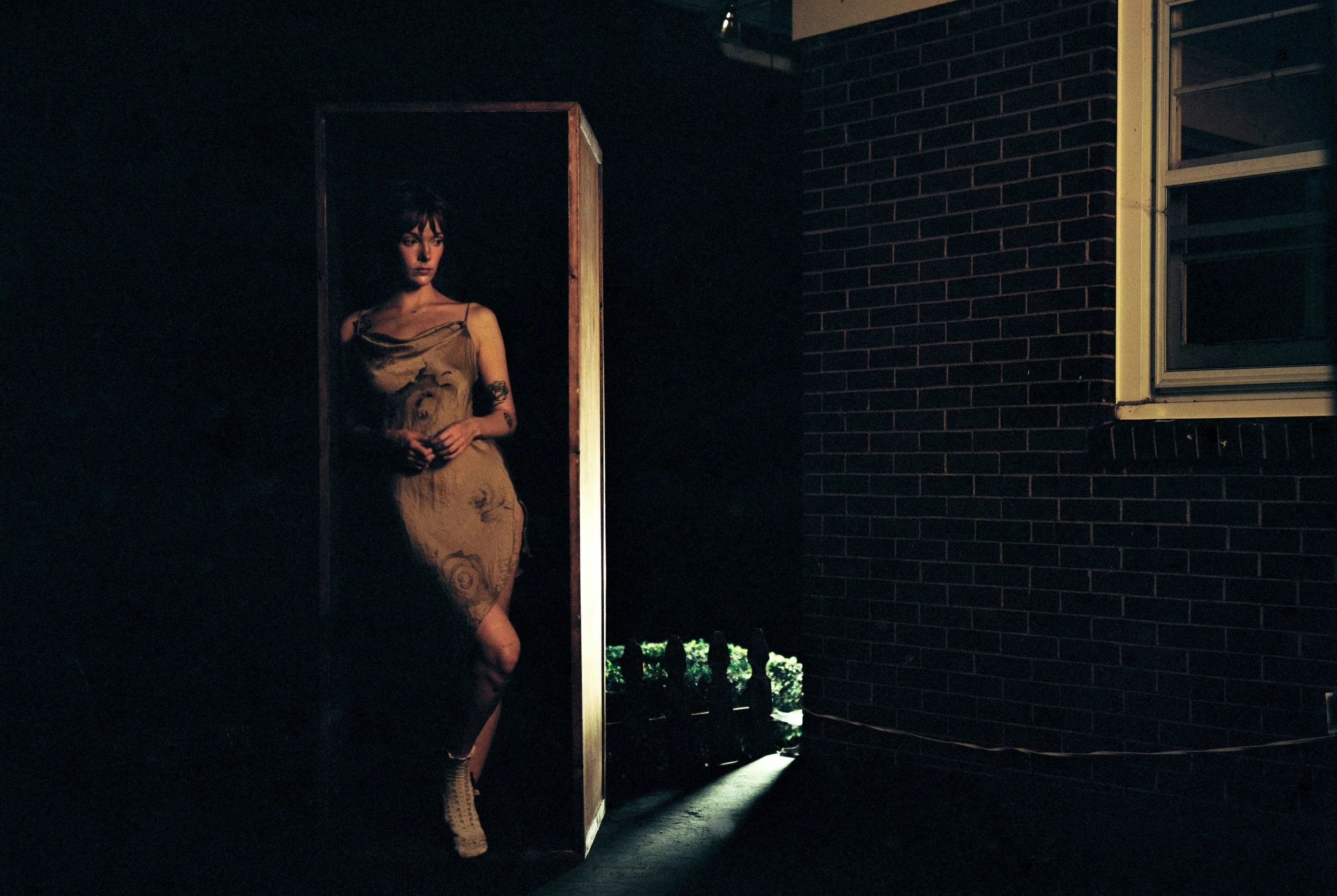
Click Image to Download!







Some albums tell a story. Fawn's Enemy, the full-length debut from Maddie Medley, builds a world.
For Maddie, that world is called Fawn's Forest. It's a place where memory, melody, rage, and resilience all share the same landscape. A place whose roads wind through rocky relationships, old habits, and new beginnings. Every path leads back to the same question: what does it mean to fully trust yourself?
Maddie has spent years learning how to ask that question. Raised in Nashville, she watched Fiona Apple headline the Ryman while still a teenager, transfixed by the singer's mix of raw vulnerability and supercharged power. Equally captivating were the songs by Patsy Cline, Gillian Welch, Damien Rice, and Tori Amos that she heard at home. Pouring those influences into her own indie folk music, she signed a major-label record deal at 20 years old — only to leave the label three years later, frustrated with an industry that seemed to champion commerce over craft.
"I needed to discover my identity outside of music," says Maddie, who found herself resettling in Kansas City and building a new life with her partner, Luke Krutzke. "I trained as a yoga teacher. I cleaned saunas. I worked at a grocery store. At first, I didn't play any music; I just let myself process."
New songs began to emerge during Maddie's quiet period of self-discovery — songs that grappled with some hard truths. "I realized that my default had been to appease whatever and whomever my body perceived as a threat," she says. "I realized I'd been projecting comfort and happiness without actually achieving either. I started the long process of undoing that." Without trying to satisfy anyone else's expectations, Maddie began writing more honestly than ever before. Steadily, Fawn's Enemy took shape.
The album's title nods to the "fawn response": the survival instinct that compels people to accommodate others during times of danger. It's an instinct Maddie knows all too well. To start demystifying and dismantling it, she wrote songs like "Fawn's Rage," "Dawn," and "★ ★ ★" (aka "Dan + Me"), all of them shaped by trauma and anchored in a renewed sense of self-empowerment. These were songs about reclaiming authorship, not only over art, but over Maddie's own life, too. The lyrics made room for characters like Rocky and Whitney — two elderly gay skunks who share a cabin in Fawn's Forest — and Teardrop, an antagonist whose name is an anagram for 'Predator.' Maddie made a physical map of Fawn's Forest, too, filling it with places like the Moon House and Fawn's Castle, dropping in a few Easter eggs for listeners who'd heard her earlier songs. She sketched a picture of Teardrop, then commissioned a puppet to be made. After years of making art full of concessions and compromise, she was finally creating something that was entirely her own — a world that was musical, visual, and even tactile. "I wasn't looking for any sort of external validation," she says of the creation process. "I wrote this for myself. I wrote it because I had to."
Produced with her partner Luke over eighteen months, Fawn's Enemy was recorded between Tennessee, Kansas City, and the couple's home in Denver. The musicians took their time, dressing up the material with warm, woody textures like mandolin, fiddle, bouzouki, upright bass, and acoustic guitar. "We captured a sound that was organic, but also very angry and imperfect, too," Maddie says. "Fawn's Enemy is a view straight into my heart, so we went after anything that sounded real." Rather than focus on polish and perfection, Maddie and Luke emphasized performances that were as raw as the lyrics themselves. On "Hills" — a love song inspired by Smashing Pumpkins' "Lily (My One and Only)" — they paired upbeat hooks with Josie Toney's fiddle and Luke Shepherd's pulsing percussion. On "Maybe in Your House," they turned an anxious guitar pattern into the foundation of a song about self-assurance. On "Whittle," Maddie transformed oppression into fuel for her own power. "Don't whittle me down if you don't want me sharp," she sings over a mix of banjo, harmonica, and mandolin, pairing the sounds of her hometown — where artists like The Chicks helped shape her sense of melody — with the liberated lessons she learned after leaving Tennessee and heading west.
In Fawn's Enemy, the enemy isn't always another person. Sometimes it's an unhealthy pattern, an old fear, or the people-pleasing impulse to betray your own instincts in exchange for acceptance. Sometimes it's yourself. "Fawn can be tender, she can be spiteful, she can be self-destructive, she can be strong-willed and self-assured," Maddie explains. Those traits all color the music itself, giving it arc and atmosphere.
The result is a quiet record whose message won't be silenced. An album for the hushed hours that bookend the day. One that speaks softly, but whose convictions are unwavering. At the center of that sound is Maddie's voice: an instrument that sounds like it was ripped out of a previous decade, blurring the differences between folk, moody pop, country, and jazz-inflected phrasing. Her influences can be felt, but they're never imitated. That's because Fawn's Enemy was made with one rule in mind: that every word come from Maddie alone. Free from compromise, the album captures an artist fully trusting her instincts for the first time.
Ultimately, Fawn's Enemy isn't just Maddie Medley's first full-length release. It's a homecoming. A return to the music she always wanted to make, and to the person she had to become in order to make it. By entering the world of Fawn's Forest, listeners might find themselves navigating their own paths through fear, anger, and acceptance. "My biggest hope is that the album provides some healing for listeners," Maddie says. "I hope people receive it as an invitation to become closer with themselves." The destination isn't a place where you find all the answers. It's the freedom that comes from trusting yourself enough to keep moving forward.
Fawn's Enemy understands that vulnerability and strength often arrive together. That intuition is something earned through practice. And, ultimately, that returning to yourself can be the most adventurous journey of all. After years spent searching for her voice, Maddie Medley finally lets it speak for itself.